
By Nikki May
On a cool, breezy spring day, several members of Saugeen Nature met at Scone to start a tour of the wetlands of Bruce County that lie along the County Road 10. Several migrating birds were seen on the pond in Scone, including Common Merganser, Bufflehead – both diving ducks, and Barn Swallows, insectivores whose populations are declining precipitously.
From late March to the end of April, waterfowl and their feathered kin migrate to or through Grey and Bruce Counties, coming up from southern locales where they have spent the winter. Some of these birds stay with us for the summer, nesting and raising young, and then return south where they can find food and shelter for the winter. Others continue on to the Boreal Forest, the taiga, or the tundra, where they are well-adapted to nest and raise their young.
Some examples of ducks that stay in Bruce and Grey include the Common Merganser and Wood Duck, both of which nest in hollows in trees carved out by woodpeckers. Once hatched the young jump from the nest and fall to the ground (and bounce), then follow their mother to the water where they spend the majority of their lives.
Other waterfowl like the Tundra Swan, the Green-winged Teal, and the Northern Shoveller, travel far to the north to nest and raise young. In the winter these three species mostly fly south for the winter. Both the Green-winged Teal and the Northern Shoveller nest on dry ground near the water.
An interesting variation on waterfowl homes are nests that are built out over the water. The feathered architects weave vegetation in and around reeds so that the nest is suspended above the water. The Ring-necked Duck does this right here in the wetlands of Grey and Bruce counties and sometimes even builds a ramp so that the female can come and go from the nest while she is brooding the eggs.
Several duck species can be seen in the winter around southern Ontario. Some individuals of the Hooded Merganser spend their winters around the shores of the Great Lakes. Red-breasted Mergansers also spend their winters here, as do the Common Merganser, the Common Goldeneye, and the Long-tailed Duck. The latter actually spends its winters far from shore, so they are hard to spot. They have no trouble weathering winter storms that cause human sailors to head for port.
This group of birds are endlessly fascinating to watch and learn about. Their beauty and variety of plumage make them wonderful to watch, and the variety of life styles and adaptation to their environments can be absorbing and intriguing. Members of Saugeen Nature venture out every year in April to try to catch sight of some of these fascinating creatures. If you are interested in joining us, go to www.saugeenfieldnaturalists.com to learn about our events. All of them are open and free to members of the public.
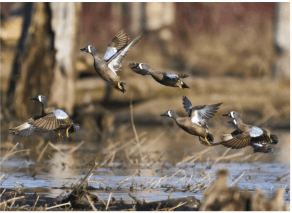
Blue-winged Teal
Photographer John Reaume