
By Nikki May
On a cool May morning, members and guests of Saugeen Nature met to explore the trail along the esker on the Inksetter property. This wooded wetland property is adjacent to Grey County’s Fish Hatchery Forest, so is part of a large forested wetland complex rich in a wide variety of plants and animals. Dylan and Angus Inksetter led the group past a large open pond, where cedar grew beside the path upland from the shoreline, and then along an esker that extends for a long way into the property. At the beginning of the trail can be found Sensitive Fern, the spears of Yellow Flag (not yet in bloom), and waterside sedges and reeds.
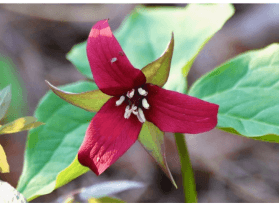
Photo by Jerry Asling
Further along the esker we came to dry upland woodlands dominated by deciduous trees and a forest floor rich with a diverse array of blooming spring ephemerals. We found Red and White Trilliums, Bloodroot, Wild Ginger, Solomon’s Seal, Starry Solomon’s Seal, Blue Cohosh, Baneberry, Canada Mayflower, Round-leaved Hepatica, Bellwort, Toothwort, Jack-in-the-Pulpit not quite in bloom, and several more. These plants bloom in the spring to take advantage of the sunlight before the forest canopy closes. They usually have set their seed by the end of May, depending on the weather and the species. Many of them can be found in woodlands across Grey and Bruce Counties, their leaves persisting into the summer months.
Down in the lower, wetter land on either side of the esker, we could see Marsh Marigold in bloom and the spears of Yellow and Blue Flag, as well as a wealth of other wetland species too far away to identify. For lack of time, we refrained from climbing down the steep sides of the esker to get a closer look.
Interspersed among the wildflowers were several species of fern typical of Grey woodlands; Maidenhair Fern just uncurling, Bulblet Fern, and various Woodland Ferns. These form a feathery contrast to the broader leaves of the flowering species and grow well in the shade all summer long.
Along the way, the group took a few moments here and there to comment on the diversity of trees in this woodland along the esker. There were large old Sugar Maples, Hop Hornbeam with a flaky bark, White Ash with deep furrowed bark, American Beech with a silvery bark, and Black Cherry with its dark bark that is usually described as looking like black cornflakes. Smaller trees like the common Chokecherry and the rarer Blue Beech grow on this esker as well. Large trunks of fallen trees act as nurseries for moss, fungi, and even young seedlings if they are old enough to have accumulated some humus on the top.