By Nikki May
It was a glorious sunny Saturday in mid-October. After several days of rain, members of Saugeen Nature ventured out to explore the northern parts of Georgian Bluffs and learn some of the geological history that formed Georgian Bay and the Bruce Peninsula. The group met our leader for the day; Bob Gray, in Kemble and car-pooled from there to the top of the hill on Kemble Rock Road. At that point there is a sweeping view across the Big Bay section of Georgian Bay, White Cloud Island and Griffith Island, and the south-eastern flank of the Bruce Peninsula.
Another short drive and we stopped to look at a rock feature next to the road. Here, an exposed rock face was comprised of hundreds of layers of shale, the edges of which were slowly eroding into a talus slope below. This formation was deposited at the edges of glacial lakes as they receded and millions of shells were crushed together with clay and fine rock. The mind boggles at the height of the glacier in this region, where an ancient lakeshore would have been located on what is now relatively high ground.
Next, we drove to the shoreline of Georgian Bay where Bob talked to us about how the Bruce Peninsula was formed; part of the Niagara Escarpment formation where harder dolostone ridges and cliffs resisted the erosion caused in the softer surrounding limestone. When the glaciers came through in successive waves, high pressure water streams formed along softer channels underneath them and these streams drove rocks against the dolostone formation of the Peninsula, carving out the series of curved bays that we can see on the east side of the peninsula.
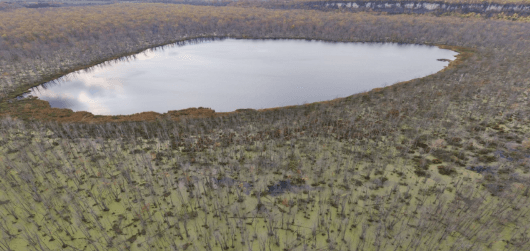
For the finale, Gray led us to a road up to Skinner’s Bluff overlooking the Slough of Despond. The group hiked along a portion of the Bruce trail to a good viewing point where Gray told us how the slough was formed. At one time when the water was higher there was a bay here. Wave action caused a barrier to form across the mouth of the bay over time, forming two lagoons. As the water receded the lagoon was isolated and is now inland. Over time the vegetation that grew up around the lagoon became boggy and now the water is surrounded by a continuous mat of sphagnum moss, which in turn is surrounded by a swamp. Settlers trying to traverse this difficult terrain named it the Slough of Despond after John Bunyan’s allegorical bog in Pilgrim’s Progress that the hero, Christian, has to fight his way through on the path to salvation– a story that early Christian settlers would know well.
All in all, this was a very educational and interesting trip with spectacular scenery and an invigorating hike near the end. A wonderful way to spend a lovely fall day.